
Project Managers Are Not Note Takers (And We Need to Stop Pretending They Are)

Let me guess.
You show up to a meeting prepared.
You’ve reviewed the timeline, identified the risks no one else has noticed yet, thought through the dependencies, and already know the three decisions that need to happen for this project to move forward.
And then someone smiles and says:
“Awesome — can you take notes?”
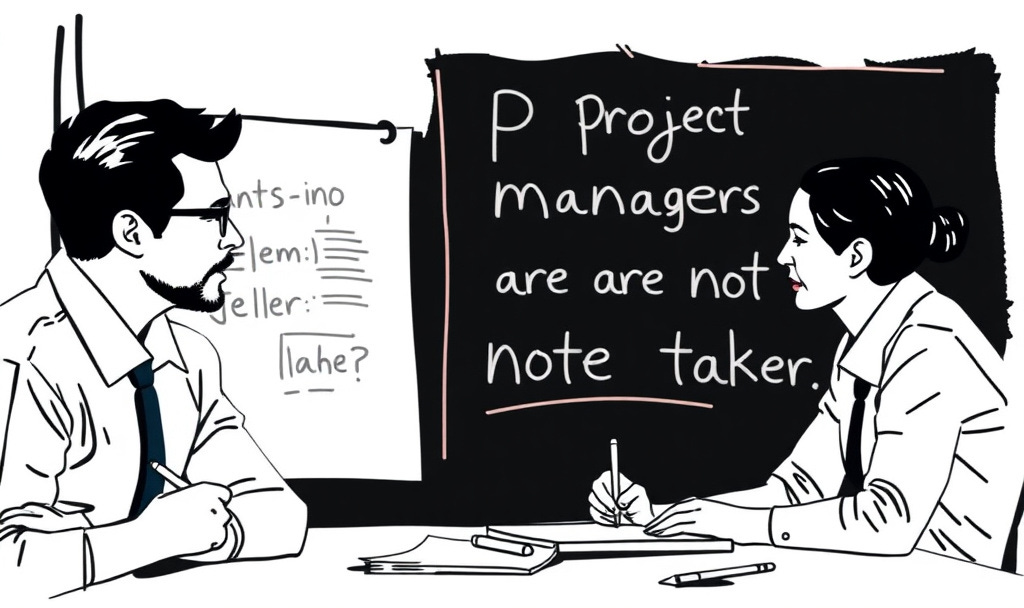
Ah yes.
The ancient project management ritual: being reduced to the team’s human transcription service.
It’s almost funny… except it isn’t.
Because buried inside that innocent request is a misunderstanding that project managers have been dealing with for years:
A lot of organizations don’t actually understand what project managers do.
The Great PM Misconception
Somewhere along the way, project management got flattened into an administrative role.
The person who schedules meetings.
The person who sends reminders.
The person who writes down what everyone else says.
Basically: corporate babysitting with a Microsoft Teams invite.
And look — notes matter. Documentation matters.
But if the full value of a project manager is “someone who captures action items,” then something has gone very wrong.
Project managers are not there to record the work.
They are there to make sure the work gets delivered.
What Project Managers Actually Do All Day
A skilled project manager is doing about 40 things that no one sees.
They’re managing:
Stakeholder expectations (often wildly unrealistic ones)
Competing priorities across departments
Scope creep disguised as “just one small change”
Risks that everyone will care about… two weeks too late
Team bandwidth, deadlines, and burnout
The constant gap between strategy and reality
Project management is not clerical.
It’s applied systems thinking.
It’s structured leadership.
It’s the discipline of turning chaos into progress.
The best PMs aren’t “just organized.”
They’re navigators.
Why Managers Often Don’t Get the Role
Here’s the uncomfortable truth:
Many managers have never been trained to understand project management as a profession.
They came up through engineering, operations, sales, or product roles where execution meant doing the thing yourself.
So when a project manager enters the picture, they assume the PM is there to support the “real work.”
But delivery is real work.
Coordination is real work.
Creating alignment across five teams who all think they’re the priority is very real work.
And when leadership doesn’t understand that, the project manager becomes an afterthought until something goes wrong.
Which leads to a predictable cycle:
PM is treated like an admin
Project lacks real structure
Issues build quietly
Deadlines slip
Everyone panics
Suddenly the PM is asked, “Why didn’t you catch this sooner?”
(We did. Three weeks ago. In the risk log. That no one read.)
The Cost of Minimizing Project Management
When project managers are pushed into the role of “note taker,” organizations lose one of the most important functions in delivery:
The person responsible for forward motion.
A project without true project management becomes:
A series of meetings with no decisions
A timeline that’s more hope than plan
A team that feels busy but not effective
A slow drift into confusion and frustration
The project doesn’t fail all at once.
It fails gradually — through misalignment, unclear ownership, and unmanaged risk.
The project manager is supposed to prevent that.
Not document it.
Reclaiming the Role
Project managers need to advocate for what the job actually is.
Not in an ego-driven way — but in a clarity-driven one.
We are not there to type quietly in the corner.
We are there to ask:
What decision needs to be made today?
Who owns this outcome?
What are we not talking about that will hurt us later?
What does “done” actually mean?
Project management is not about notes.
It’s about outcomes.
So yes, we can take notes.
But if that’s all you think we do…
You’re missing the entire point of the profession.
And probably the reason your projects keep going off the rails.
MPMM can help keep your projects on the rails!
All 7 MPMM Products are included in this bundle:
Project Management Methodology with embedded templates
Program Management Methodology Module
Project Portfolio Management (PPM) Module
IT Lifecycle Module
Agile Module
Budget Template
Risk Template